WestWorld: A Knowledge-Encoded Scalable
Trajectory World Model for Diverse Robotic Systems
 ICML 2026 Spotlight
 TL;DR
- We propose WestWorld, a novel system-aware MoE architecture for scaling up the training of trajectory world models across diverse robotic systems.
- We introduce knowledge-encoded structural embedding that provides an explicit inductive bias to enhance zero- and few-shot generalization to unseen robotic systems.
- We conduct extensive experiments to verify the scalability and generalizability of our method, and apply it to a downstream model-based control task, demonstrating strong performance in long-horizon planning.
Methodology
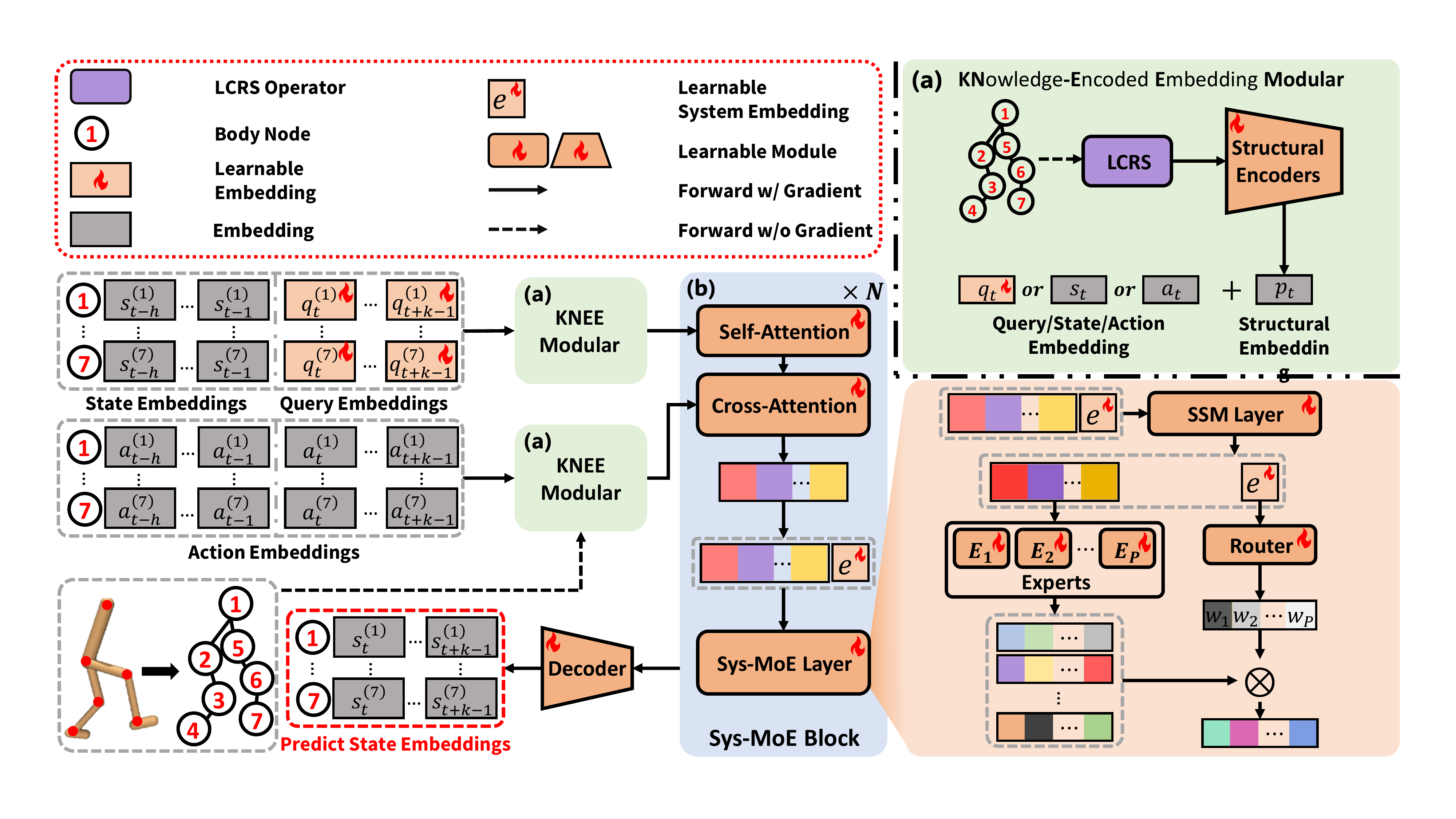
Figure 1: WestWorld Framework Overview. The overall architecture of our proposed WestWorld, consisting of two core components: (a) a Knowledge-Encoded Embedding Module that injects structural embeddings as an inductive bias into trajectory representations, and (b) a System-aware MoE block that models diverse system dynamics via system-aware expert routing.
Experiments
Evaluation on Zero-shot Performance
| Method | Walker2D (×10⁻²) | Hopper (×10⁻²) | Franka (×10⁻²) | |||
|---|---|---|---|---|---|---|
| MAE ↓ | MSE ↓ | MAE ↓ | MSE ↓ | MAE ↓ | MSE ↓ | |
| MLP Ensemble | 26.006 | 12.028 | 19.987 | 7.216 | 12.164 | 4.271 |
| TDM | 20.122 | 6.428 | 17.634 | 5.076 | 23.686 | 8.435 |
| TrajWorld | 22.261 | 8.623 | 17.388 | 5.441 | 13.102 | 5.127 |
| WestWorld (Ours) | 16.350 | 5.064 | 13.731 | 3.368 | 7.737 | 2.539 |
Table 1: Zero-shot generalization performance. We evaluate zero-shot performance on three unseen robotic environments: Hopper and Walker2D from D4RL, and a real-world Franka manipulator. WestWorld outperforms all baselines across all systems, demonstrating that our system-aware MoE architecture and structural inductive bias effectively capture distinct dynamics while mitigating task interference.
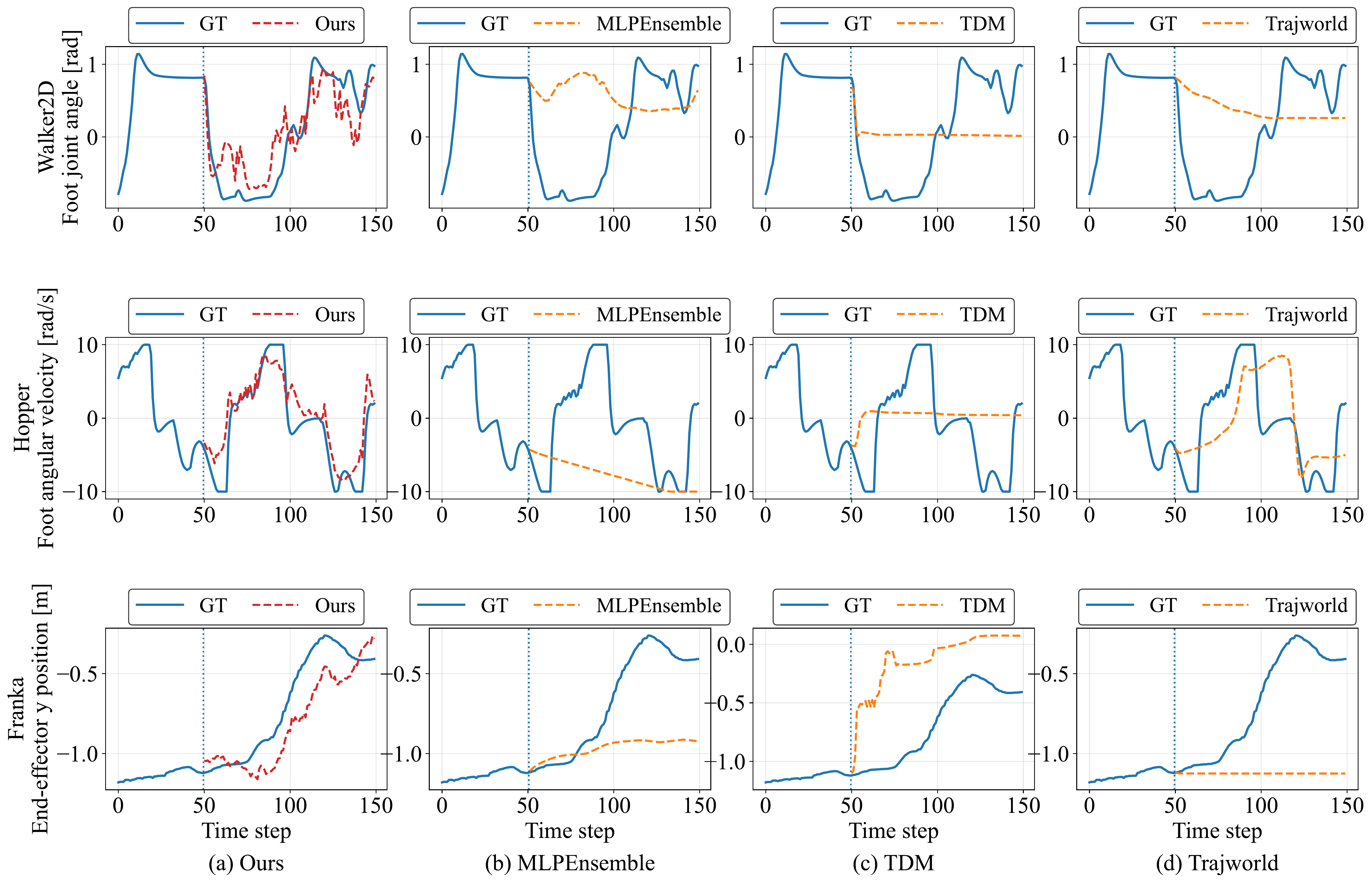
Figure 2: Trajectory visualization for zero-shot generalization. WestWorld tracks the ground-truth dynamics substantially more closely than the baselines over the 100-step horizon. In a zero-shot setting on unseen but structurally similar systems, our model selects appropriate experts to produce accurate dynamics predictions, whereas baseline methods lack morphology-aware representations and fail to generalize.
Evaluation on Few-shot Adaptation
| Method | Cassie (×10⁻²) | A1 (×10⁻²) | UR5 (×10⁻²) | |||
|---|---|---|---|---|---|---|
| MAE ↓ | MSE ↓ | MAE ↓ | MSE ↓ | MAE ↓ | MSE ↓ | |
| MLP Ensemble | 14.369 ± 0.523 | 4.416 ± 0.368 | 14.357 ± 1.009 | 3.707 ± 0.523 | 15.181 ± 0.597 | 4.936 ± 0.322 |
| TDM | 14.510 ± 0.642 | 3.404 ± 0.300 | 10.624 ± 0.312 | 2.151 ± 0.109 | 18.578 ± 0.324 | 5.510 ± 0.175 |
| TrajWorld | 7.834 ± 0.167 | 1.697 ± 0.109 | 5.138 ± 0.200 | 0.900 ± 0.050 | 8.066 ± 0.799 | 2.117 ± 0.433 |
| WestWorld (Ours) | 5.316 ± 0.108 | 0.808 ± 0.025 | 4.227 ± 0.120 | 0.628 ± 0.040 | 4.925 ± 0.317 | 0.831 ± 0.150 |
Table 2: Few-shot adaptation performance. We evaluate few-shot adaptation (10 episodes per system) on three real-world datasets with significant domain gap: Cassie bipedal jumping, Unitree A1 quadruped locomotion, and UR5 tabletop manipulation. Despite the large morphology and dynamics gap, WestWorld consistently outperforms all baselines, showing that pretraining provides strong initialization even for systems with substantial domain differences.
Evaluation on Scalability
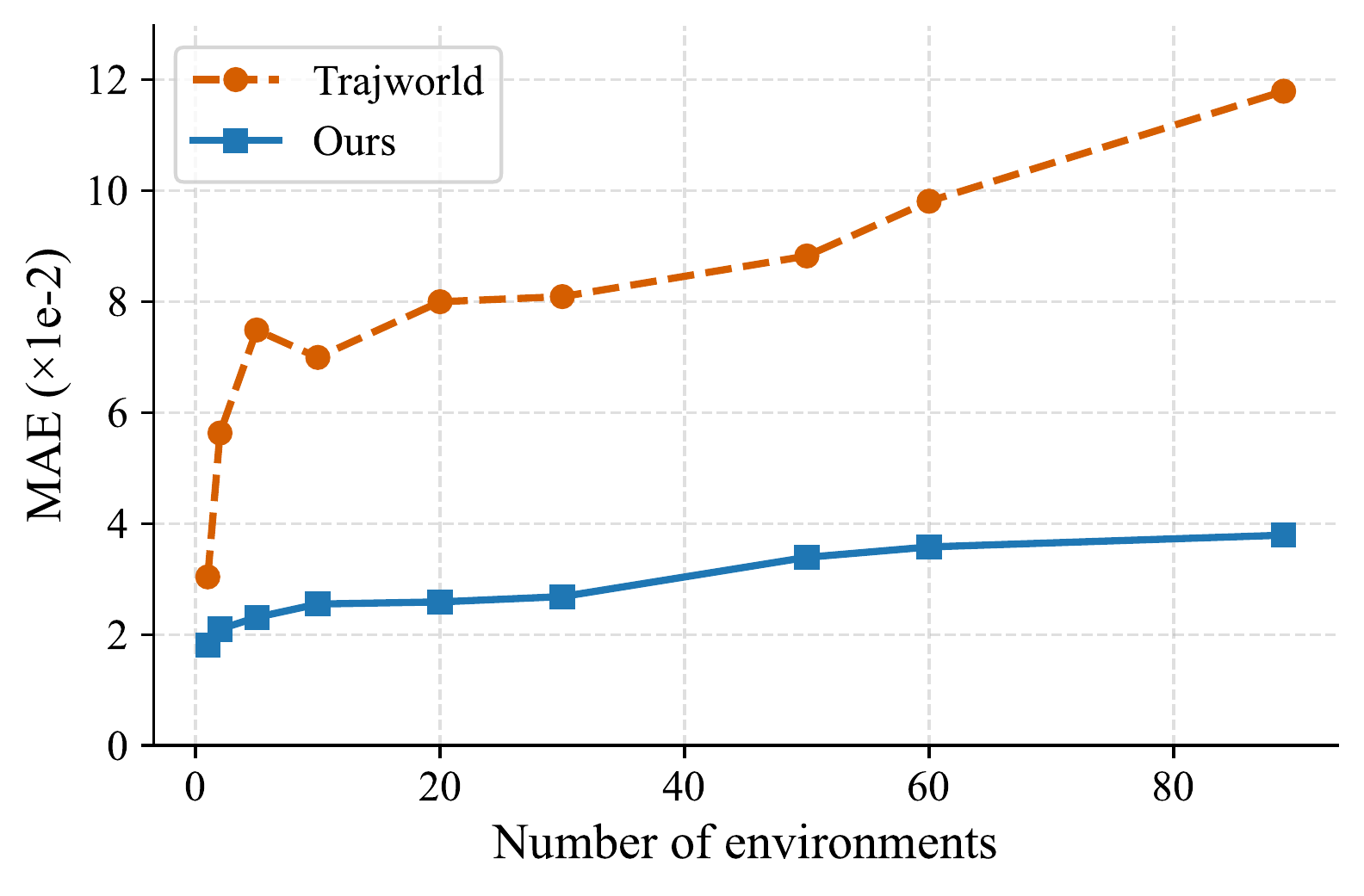
Figure 4: Scalability comparison. We pretrain on N = 1, 2, 5, 10, 20, 30, 50, 60, 89 environments. WestWorld's accuracy stays consistently low as N grows, while TrajWorld degrades substantially due to gradient interference, demonstrating our model's scalability across diverse environments.
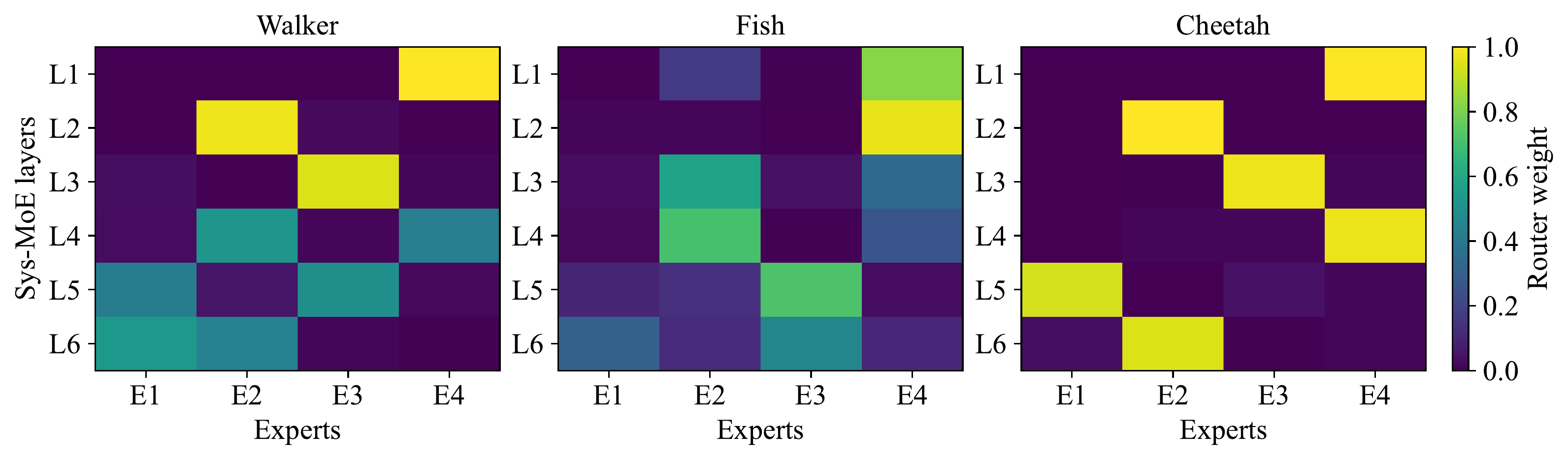
Figure 3: Sys-MoE routing weights across six layers (L1–L6) with four experts (E1–E4). Brighter colors indicate higher expert activation. The router exhibits sparse, system-dependent expert selection, where different systems use different expert combinations to capture their distinct dynamics. This validates our key insight that complex dynamics can be approximated by composing basis dynamics modules, mitigating interference and enabling scalable pretraining.
Evaluation on Downstream Control Task
| Method | Pretrain | Walker2D | Hopper | Go1 |
|---|---|---|---|---|
| Reward ↑ | Reward ↑ | Reward ↑ | ||
| MLP Ensemble | ✗ | 119.18 | 147.37 | -1.07 |
| ✓ | 190.51 | 200.56 | -0.31 | |
| TDM | ✗ | 122.65 | 242.34 | -0.72 |
| ✓ | 207.61 | 154.64 | 0.03 | |
| TrajWorld | ✗ | 395.23 | 366.26 | 0.05 |
| ✓ | 1933.52 | 534.32 | 0.49 | |
| WestWorld (Ours) | ✗ | 707.61 | 554.92 | 0.43 |
| ✓ | 2134.60 | 2253.51 | 2.20 |
Table 3: Downstream control performance using MPPI. We report accumulated episode reward averaged over evaluation episodes, comparing fine-tuning from pretrained checkpoint vs. training from scratch on Walker2D, Hopper, and Go1. Pretraining consistently improves control performance across nearly all methods, and WestWorld achieves the best performance under both regimes with particularly large gains after pretraining.
Pretraining Yields Largest Gains for WestWorld
Go1 Quadruped (Walk Straight)
Hopper (Hop Forward)
Walker2D (Walk Forward)
Real-World Deployment Comparison on the Go1 Quadruped
Ablation Study
| Method | Sys-MoE | Structural Embedding | Walker2D (×10⁻²) | Hopper (×10⁻²) | Franka (×10⁻²) | |||
|---|---|---|---|---|---|---|---|---|
| MAE ↓ | MSE ↓ | MAE ↓ | MSE ↓ | MAE ↓ | MSE ↓ | |||
| Ours w/o Sys-MoE | ✗ | ✓ | 18.707 | 6.797 | 15.978 | 4.630 | 9.392 | 2.873 |
| Ours w/o Structural Embedding | ✓ | ✗ | 21.156 | 7.872 | 16.227 | 4.990 | 7.897 | 2.707 |
| WestWorld (Ours) | ✓ | ✓ | 16.350 | 5.064 | 13.731 | 3.368 | 7.737 | 2.539 |
Table 4: Ablation study under zero-shot setting. We ablate Sys-MoE by replacing it with a dense SSM, and ablate structural encoding by removing it during pretraining. Removing structural embedding degrades performance on complex morphologies (Hopper, Walker2D), indicating that modeling physical connectivity improves generalization. Replacing Sys-MoE with dense SSM also degrades performance, confirming it mitigates inter-task interference. Both components are essential for model generalization and scalable pretraining.